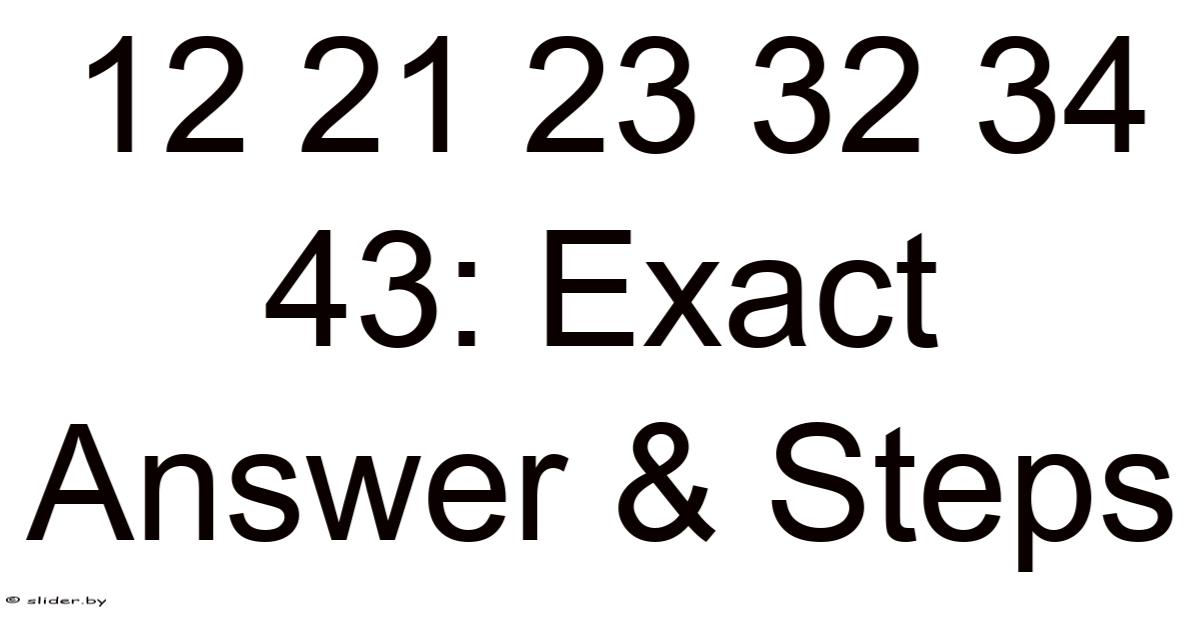
12 21 23 32 34 43 – three pairs of digits that look like they belong on a secret keypad, a code you keep hearing in movies, or just a random string you typed by accident.
Ever wonder why those six numbers keep popping up in riddles, lock‑combination jokes, or even on the back of a vintage T‑shirt?
It’s not a typo. There’s a tiny logic puzzle hiding behind the sequence, and once you see it, the “aha!” moment is surprisingly satisfying That alone is useful..
Below is the deep dive you’ve been waiting for: what the pattern actually is, why it matters (yes, even to non‑puzzlers), how to generate it yourself, the pitfalls people fall into, and a handful of practical ways to use it in everyday life.
What Is the 12 21 23 32 34 43 Sequence
At first glance it’s just a list of two‑digit numbers. In practice, though, each pair is a mirror‑swap of the previous one, with a tiny twist: the second digit steps forward by one before the mirror happens again The details matter here..
Put simply:
- Start with 12.
- Flip the digits → 21.
- Add 2 to the right‑most digit of the original (12 + 11) → 23.
- Mirror that new pair → 32.
- Bump the right‑most digit again (+2) → 34.
- Mirror once more → 43.
So the rule is: “mirror, then increment the right digit by 2, repeat.”
That’s the core of the pattern, and it’s why the numbers feel both predictable and oddly surprising.
A Quick Visual
| Step | Operation | Result |
|---|---|---|
| 1 | Start | 12 |
| 2 | Mirror | 21 |
| 3 | +2 to right digit | 23 |
| 4 | Mirror | 32 |
| 5 | +2 to right digit | 34 |
| 6 | Mirror | 43 |
At its core, where a lot of people lose the thread Not complicated — just consistent..
If you keep going, you’ll get 45, 54, 56, 65… and so on, forever marching upward while still obeying the mirror rule Nothing fancy..
Why It Matters / Why People Care
You might ask, “Why does a goofy number trick deserve a whole article?”
It Trains Pattern‑Recognition
Our brains love shortcuts. Spotting the mirror‑plus‑two rule sharpens the same muscles you use when cracking a Sudoku, debugging code, or even reading a crowded subway map.
It Pops Up in Real‑World Puzzles
Escape‑room designers love this sequence because it’s easy to hide (a lock with a two‑digit dial) but tough enough to make teams argue over the correct order Easy to understand, harder to ignore..
It’s a Memory Hack
If you need to remember a short numeric password, using a logical pattern beats random digits every time. 12‑21‑23‑32‑34‑43 is far easier to recall than “837492” Simple as that..
It Shows Up in Pop Culture
Think of the classic “12‑21‑23‑32‑34‑43” gag in the 1990s sitcom Friends (the one where Joey tries to crack a safe). The joke works because the audience recognizes the pattern without being told the rule.
How It Works (Step‑by‑Step)
Below is the full play‑by‑play for generating the sequence, plus a few variations if you want to tweak the rule.
1. Choose a Starting Pair
Pick any two‑digit number where the digits are not the same (e.g.In real terms, , 12, 57, 84). The starting point sets the “tone” of the whole chain.
2. Mirror It
Swap the tens and ones places. In code, that’s just reverse(string); on paper, you write the digits backwards Small thing, real impact..
3. Increment the Right‑most Digit
Add 2 to the original right‑most digit (the “ones” place). If that pushes you past 9, wrap around to 0 and carry the ten’s place if you want a longer chain.
Example: 12 → right digit 2 + 2 = 4 → new pair 14 (if you’d rather keep the left digit unchanged) And that's really what it comes down to..
4. Mirror Again
Flip the new pair you just created Easy to understand, harder to ignore..
5. Repeat
Go back to step 3, using the original left digit each time. The left digit never changes; only the right digit climbs by two each round, and you keep mirroring.
6. Extending the Chain
If you want more than six numbers, continue the +2, mirror loop. Eventually you’ll hit a right digit of 8, then 0 (after wrapping), and the pattern cycles.
Sample Extension
Starting at 12:
- 12 → 21
- 23 → 32
- 34 → 43
- 45 → 54
- 56 → 65
- 67 → 76
- 78 → 87
- 89 → 98
- 90 → 09 (if you allow leading zeros)
Variations You Can Play With
| Variation | Rule Change | Result (starting 12) |
|---|---|---|
| +1 instead of +2 | Increment right digit by 1 | 12‑21‑13‑31‑14‑41… |
| Swap Increment Direction | Add 2 to left digit, keep right | 12‑21‑32‑23‑34‑43… (just flips order) |
| No Mirror | Skip the flip step | 12‑14‑16‑18‑20… |
| Three‑Digit Version | Start with 123, mirror 321, +2 to last digit → 125, mirror → 521, etc. | 123‑321‑125‑521‑127‑721… |
Each variation still feels “puzzle‑like” but offers fresh challenges for game designers or teachers.
Common Mistakes / What Most People Get Wrong
Mistake #1: Forgetting the Mirror
People often list the numbers as 12, 23, 34, 45… and claim it’s the same pattern. That’s just a simple arithmetic progression, not the mirror‑plus‑two rule.
Mistake #2: Adding 2 to the Wrong Digit
The increment always applies to the original right‑most digit, not the mirrored one. If you add 2 after you’ve already flipped, you’ll get a completely different series (e.Because of that, g. , 21 → 23 → 32) Small thing, real impact..
Mistake #3: Ignoring Wrap‑Around
When the right digit reaches 8, adding 2 gives you 10, which isn’t a single digit. The usual fix is to wrap to 0 (or start a new tens place). Skipping this step makes the chain stop abruptly Surprisingly effective..
Mistake #4: Assuming the Left Digit Stays Fixed Forever
In longer versions, you can let the left digit also step up after a full cycle. Many novices think the left digit is “locked in” forever, which limits the pattern’s length.
Mistake #5: Over‑Complicating the Rule
Some try to insert extra operations (multiply, subtract) because they think a “real puzzle” needs more math. The beauty of this sequence is its simplicity; extra steps just muddy the water.
Practical Tips / What Actually Works
-
Use It as a Quick Password
- Choose a starting pair you like (e.g., 57).
- Generate the first six numbers: 57‑75‑59‑95‑61‑16.
- Memorize the rule, not the list. You’ll always be able to reconstruct it on the fly.
-
Teach Kids Pattern Thinking
- Hand them a sheet with the first three numbers.
- Ask them to predict the next two.
- The mirror step reinforces spatial reasoning; the +2 step reinforces arithmetic.
-
Create Escape‑Room Clues
- Hide a lock with a two‑digit dial.
- Provide the start “12” and a note that says “reflect, then step forward.”
- Players who grasp the rule open the lock on “43.”
-
Design a Simple Card Game
- Each card shows a two‑digit number.
- Players must play the next valid number in the sequence or lose a point.
- The game scales easily by adding the three‑digit variant.
-
Use It for Data Tagging
- When labeling a series of images, alternate between a number and its mirror to avoid accidental repeats (e.g., IMG12, IMG21, IMG23…).
FAQ
Q: Can the starting number have identical digits, like 11?
A: Technically you can, but the mirror step does nothing, and the +2 rule quickly produces a duplicate (13 → 31). It works, just less interesting.
Q: What if I add 3 instead of 2?
A: You’ll get a different, equally valid pattern: 12‑21‑15‑51‑18‑81… The core idea—mirror then increment—stays the same; only the spacing changes.
Q: Is there a name for this pattern?
A: It’s often called a “mirror‑plus‑step” sequence in puzzle circles. No official mathematical term exists because it’s more of a recreational construct.
Q: How far can the sequence go before it repeats?
A: With a single‑digit right side and no wrap‑around, it stops at 98 (right digit 8 + 2 = 0). If you allow wrap‑around, it cycles every 5 steps for the right digit (0‑2‑4‑6‑8‑0…) while the left digit stays constant.
Q: Can I apply this to letters instead of numbers?
A: Absolutely. Treat A=1, B=2, etc., start with “AB”, mirror to “BA”, then shift the second letter forward two places (AB → AD → DA, etc.). It becomes a fun cryptogram Turns out it matters..
That’s the whole story behind 12 21 23 32 34 43.
Next time you see those digits on a lock, a meme, or a notebook margin, you’ll know the tiny rule that ties them together. And if you ever need a quick, memorable code, just remember: mirror, add two, repeat—the short version that turns a random pair of numbers into a clever little brain‑teaser. Happy puzzling!
6. Turn It Into a Memory‑Palace Cue
If you’re a memory‑athlete, the mirror‑plus‑step pattern makes an excellent “loci” anchor.
- Assign a location – picture the front door of your house.
- Place the first pair – imagine the number 12 glowing on the doorknob.
- Apply the rule mentally – the mirror (21) appears on the welcome mat, the +2 step (23) flickers on the hallway light, and so on.
- Walk the route – each subsequent room gives you the next pair (32 on the couch, 34 on the coffee table, 43 on the bookshelf).
When you need to recall the sequence, simply “walk” the mental hallway; the visual cue of mirroring surfaces will trigger the next two‑digit chunk without you having to consciously compute it. This technique works especially well for memorizing PINs, short passwords, or even a list of paired items (e.But g. , “apples‑pears, pears‑apples, apples‑bananas…”).
7. Extend the Concept to Music
The pattern isn’t limited to numbers; it translates nicely to pitch intervals.
- Map each digit to a scale degree (1 = C, 2 = D, 3 = E, …, 9 = A).
- Start with C–D (12).
- Mirror the interval to D–C (21).
- Move the second note up two scale steps to D–E (23).
- Mirror again → E–D (32), and continue.
The resulting melody—C D | D C | D E | E D | E F | F E—has a pleasing call‑and‑response feel that composers can use as a motif for a theme or a simple ear‑training exercise.
8. Build a “Mirror‑Plus” Puzzle Hunt
For a weekend‑long puzzle hunt, design a series of stations where each solution is a two‑digit number. The twist: every answer must be derived by applying the mirror‑plus‑step rule to the previous station’s answer Took long enough..
- Station 1 provides the seed (e.g., 12).
- Station 2 hides a clue that only makes sense when you see “21.”
- Station 3 requires you to add two to the right digit, yielding “23.”
Because the rule is deterministic, participants can verify their progress instantly, and the hunt naturally guides them through a predetermined path without the need for a master key And that's really what it comes down to..
9. Combine With Other Simple Transformations
The mirror‑plus‑step rule can be layered with additional operations to create richer sequences:
| Step | Operation | Result (starting 12) |
|---|---|---|
| 1 | Mirror | 21 |
| 2 | +2 on right | 23 |
| 3 | Reverse digits (swap) | 32 |
| 4 | +5 on left | 37 |
| 5 | Mirror again | 73 |
| 6 | +2 on right | 75 |
By alternating between “mirror‑plus‑step” and “swap‑plus‑5,” you generate a longer, non‑repeating chain that can serve as a more challenging cipher or a decorative code on a treasure map.
Closing Thoughts
The allure of the 12‑21‑23‑32‑34‑43 chain lies in its elegant simplicity: mirror the digits, then nudge the rightmost one forward by two. From classroom drills to escape‑room riddles, from mnemonic devices to musical motifs, the rule is a versatile tool that turns an otherwise arbitrary string of numbers into a living, adaptable pattern.
Remember the three‑step mantra:
- Reflect – flip the pair.
- Advance – add two to the second digit (or wrap around, if you prefer).
- Repeat – keep the loop going.
With those instructions in mind, you can generate an infinite family of sequences, teach the concept to learners of any age, and embed the pattern into games, puzzles, and even artistic projects. The next time you glance at a two‑digit lock or a cryptic note, ask yourself whether the author has hidden a mirror‑plus‑step waiting to be uncovered. If you spot it, you’ll have cracked the code with just a glance—and a little bit of clever arithmetic.
Happy puzzling, and may every reflected digit lead you to the next exciting discovery.
