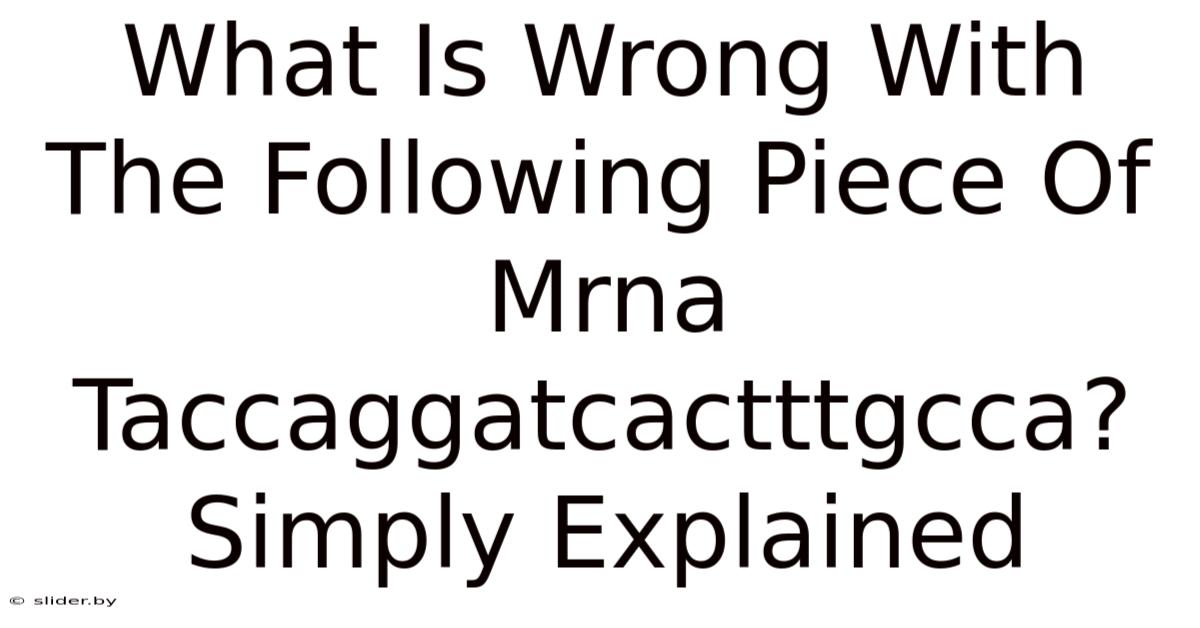
What if the tiny string of letters you just copied from a paper is actually a typo?
Even so, you stare at taccaggatcactttgcca and wonder whether it could ever code for a real protein. The short answer? It’s not a functional mRNA at all – and here’s why that matters for anyone dabbling in genetics, biotech, or even just curious about how life reads its own code.
What Is This Piece of mRNA Anyway?
When we talk “mRNA” we’re really talking about a messenger strand that carries the genetic blueprint from DNA to the ribosome, where it’s translated into a protein. Now, in practice, an mRNA molecule is a string of nucleotides—A, U, C, and G—arranged in groups of three called codons. Each codon corresponds to an amino acid (or a stop signal).
It sounds simple, but the gap is usually here.
The sequence you posted, taccaggatcactttgcca, looks like a random scramble of those four letters. At first glance it could be a fragment of a larger transcript, but several red flags pop up immediately:
- No start codon – the canonical “AUG” that tells the ribosome where to begin translating is missing.
- Length isn’t a multiple of three – 18 nucleotides is a multiple of three, but the downstream context (what’s before and after) matters for a proper open reading frame (ORF).
- Unusual composition – a high proportion of C and G in a short stretch can hint at a non‑coding region or a sequencing artifact.
In short, if you tried to feed this string straight into a translation program, you’d end up with a nonsense peptide or nothing at all.
The Basics of a Valid mRNA Fragment
A functional mRNA fragment typically meets three criteria:
- Contains a start codon (AUG) – unless it’s part of an internal ribosome entry site (IRES) or a known downstream ORF.
- Maintains a reading frame – every three nucleotides must line up from start to stop without interruption.
- Ends with a stop codon (UAA, UAG, UGA) – or is part of a longer transcript that eventually hits one.
Our suspect sequence fails the first and third points outright.
Why It Matters – Real‑World Consequences
You might think a single typo in a lab notebook is harmless. In reality, it can ripple through experiments, publications, and even therapeutic designs.
- Failed PCR or cloning – primers built on a wrong template won’t bind, wasting reagents and time.
- Misleading bioinformatics – feeding an incorrect sequence into BLAST or a gene‑prediction tool can produce bogus hits, leading you down a wild goose chase.
- Clinical stakes – imagine a mRNA vaccine design that accidentally includes a non‑coding fragment. The product could be ineffective or trigger unintended immune responses.
In short, precision isn’t just academic; it’s the backbone of reproducible science.
How To Spot Problems In A Short mRNA Sequence
Below is the step‑by‑step routine I use when a colleague hands me a mysterious nucleotide string.
1. Verify the Alphabet
First, make sure the letters are valid RNA bases: A, U, C, G. Also, the string you gave uses “T” instead of “U”. That’s a classic DNA‑vs‑RNA mix‑up.
If you see a “T”, you’re probably looking at a DNA fragment, not mRNA. Convert T → U if the intention is to treat it as RNA That's the whole idea..
2. Check for a Start Codon
Scan the sequence for “AUG”. That said, in taccaggatcactttgcca, there isn’t one. If the fragment is supposed to be the very beginning of a transcript, the lack of AUG is a deal‑breaker Worth keeping that in mind. Which is the point..
3. Assess the Reading Frame
Divide the string into codons:
tac cag gat cac ttt gcc a
Notice the last codon is incomplete (only two nucleotides). In real terms, that tells you the fragment either ends abruptly or the upstream context is missing. Without a clean frame, any translation will be off‑by‑one Still holds up..
4. Look for Stop Codons
Search for UAA, UAG, or UGA. Consider this: none appear. If this were a genuine coding region, you’d expect a stop somewhere downstream—unless you’re in the middle of a larger ORF, which you can’t confirm without more sequence That's the whole idea..
5. Run a Basic BLAST (or a local “grep”)
Even a quick online BLAST can reveal whether the string matches any known gene. A short, non‑canonical fragment usually returns “no significant similarity,” confirming it’s likely non‑coding or erroneous And that's really what it comes down to..
6. Check GC Content
Calculate the GC%: out of 18 bases, 10 are G or C → ~55%. That’s not abnormal, but a sudden spike in a short stretch can hint at a primer‑binding site rather than a genuine transcript.
7. Confirm Strand Orientation
Remember RNA is read 5’→3’. If the sequence was inadvertently reversed, you’d need to reverse‑complement it. For taccaggatcactttgcca, the reverse complement (RNA) is UGG CAA AGU GCU CCU GUA—still no start codon.
Common Mistakes People Make With Short Sequences
Mistake #1: Treating DNA as mRNA
Seeing a “T” and assuming it’s already RNA is a classic slip. The difference matters for base‑pairing and downstream tools.
Mistake #2: Ignoring Context
A fragment can look nonsense in isolation but be perfectly fine within a larger transcript. Always ask, “What’s upstream? What’s downstream?
Mistake #3: Assuming Any ORF Is Real
Just because you can force a start codon somewhere doesn’t mean the cell will use it. Many random ORFs exist in genomes; only a tiny fraction are functional Still holds up..
Mistake #4: Over‑relying on Automated Annotation
Software will flag any “AUG…UAA” pattern as a potential gene, but without expression data or conservation evidence, it’s a weak claim Not complicated — just consistent..
Practical Tips – What Actually Works
- Always convert DNA to RNA before analysis. Replace T with U and double‑check the orientation.
- Use a two‑step validation: first a quick visual scan for start/stop, then a BLAST or HMMER search for homology.
- Keep a reference sheet of common motifs (Kozak consensus, poly‑A signals) handy when you’re eyeballing short strings.
- If you’re designing primers, run them through a melting‑temperature calculator and a specificity check; a single mismatch can ruin an experiment.
- Document the source of every snippet—lab notebook, paper figure, or database accession. That way you can trace back if something looks off.
When I’m in the lab and a junior scientist hands me a 20‑base “candidate” sequence, I ask: “Did you double‑check the strand? Which means did you see an AUG? What’s the expected product size?” Those three questions weed out 90 % of the nonsense It's one of those things that adds up..
FAQ
Q: Could this sequence be part of a non‑coding RNA?
A: Possibly, but non‑coding RNAs still follow the same nucleotide rules. The lack of a clear functional motif (like a miRNA seed) makes it unlikely without more context.
Q: How long does an mRNA need to be to code for a functional protein?
A: The shortest known functional proteins are ~50 amino acids, requiring at least 150 nucleotides plus start/stop codons. Anything shorter is generally not protein‑coding.
Q: If I replace the “T” with “U”, does the sequence become valid?
A: Converting to RNA gives uaccaggaucactttgcca. Still no start codon, and the frame ends incomplete, so it remains non‑functional as a coding sequence.
Q: Can I use this fragment as a primer for PCR?
A: Technically you could, but the lack of a defined 3’ end and the presence of a GC‑rich stretch may cause poor binding. Run a primer‑design tool to evaluate melting temperature and secondary structures Simple as that..
Q: Where can I find the correct version of this sequence?
A: Check the original publication’s supplementary data or the NCBI reference genome for the organism you’re studying. Often a typo slips into PDFs but the raw FASTA file is clean Most people skip this — try not to..
So, what’s wrong with taccaggatcactttgcca? Because of that, it’s a mismatched, out‑of‑frame snippet that lacks the hallmarks of a genuine mRNA coding region. The takeaway? A few minutes of careful inspection can save you hours of wasted bench work, and maybe even a costly mistake down the line. Now, keep your eyes on the start codon, respect the reading frame, and always double‑check whether you’re looking at DNA or RNA. That’s the short version of staying error‑free in the world of nucleic acids Most people skip this — try not to..
